
Every year for 10 years, my Irish mother Isabel "Issy" and I attended the annual Irish Books Arts and Music (IBAM) weekend at the Irish American Heritage Center in Chicago.
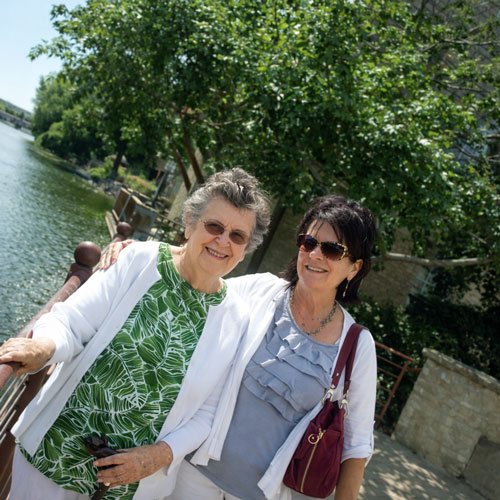
Every year for 10 years, my Irish mother Isabel "Issy" and I attended the annual Irish Books Arts and Music (IBAM) weekend at the Irish American Heritage Center in Chicago. This year, 2019, was especially significant. It fell on her 86th October birthday. Her favorite Irish novelist, journalist and broadcaster Frank Delaney was speaking, and that Sunday evening was to culminate with a concert by her beloved Northern Ireland musician Philip Coulter.
That afternoon we also were going to sneak away from the book fest for a couple of hours and head to North Avenue Beach, where lifeguards had planned a celebration of life for "The Bird Lady," Eleanor, my mom's lifelong friend who was known as the caregiver of all at the beach. Eleanor had passed just weeks before.
Eleanor was no ordinary friend. She and my mother had found each other decades earlier, in their 20s, working as legal assistants for a Chicago law firm and discovering in each other a kindred spirit. On summer weekends, the two were inseparable, laughing and lounging in the sun, young bathing beauties whose radiance captured the camera of a Chicago Daily News photographer on the cover of the weekend newspaper. As the years passed, Eleanor, with my mother happily as her sidekick, became something of a beloved institution at North Avenue Beach. She arrived each day like a one-woman welcoming committee, hauling an umbrella and enough towels to shelter half the lakefront, setting up what regulars came to know as her open-air living room. An eclectic community of friends came from every corner of the city just to pull up a chair in Eleanor's circle. She fed the birds with such faithful devotion that she earned the nickname "The Bird Lady." She baked chocolate chip cookies for the lifeguards. She knew everyone, and everyone was blessed by her kindness.
"I don't feel good, Mary," my mother phoned that morning. "I can't go today."
I knew we were crossing a line.
You have to understand. My mother was never sick, or never admitted to be. She practically invented FOMO — that Fear of Missing Out her grandkids now declare in hashtags and memes. She was a woman who thrived on being in the middle of everything: hosting gatherings, never missing a wake or a funeral, always the first to show up for a friend. For Issy to miss Eleanor's celebration of life, of all things.
That night, I gave my mom's concert ticket to an elderly lady visiting from Ireland. She was so excited and grateful. I sat in the cold auditorium and cried as Phil delivered my mom's favorite song, The Town I Loved So Well.
The next morning, I drove her to the ER, the two of us quiet in the Jeep that had carried us on so many happier adventures, the words neither of us was saying filling all the space between us.
Fast forward a month. My mother had been hospitalized for more than three weeks and was now being transferred from a west suburban hospital to Loyola Medical Center, where doctors hoped finally to name the illness that had been slowly stealing her from us.
I followed the ambulance in my Jeep, tears blurring the road ahead.
Arriving at the medical center, I walked toward the entrance and spotted a paramedic bringing another patient in on a stretcher. It was my son Thomas, who was training at Loyola at the time. He arriving at the exact same moment my mother and I came through the doors of the ER. I still hear his voice: "Hi Mom. Issy, I am here." Her face lit up.
The next day a doctor motioned me into a small room off the GI lab and delivered the diagnosis quietly. A rare and terminal cancer of the duodenum. Four months to live.
My mother was moved to her room. The nurse on call was my cousin, another Mary, Mary Therese, who walked through the door and stopped. She seemed baffled to find her aunt lying in the bed and her cousin, me sitting bedside.
"Issy, I'm here."
That afternoon, my friend Michelle, who worked in the hospital's financial department, came upstairs to visit. She took my mother's hand and sat with her.
Then my phone buzzed. A text from George, the lifeguard who had organized Eleanor's celebration of life, the one my mother had been too ill to attend. "Where was Issy? Is she okay?" When I told him she was in the hospital, his reply came quickly: "Please tell her the lifeguards are praying for her. We love her."
I sat with that for a moment. The beach, Eleanor, the birds, the lifeguards, the buddies at the beach, still rippling outward, being present for Issy, even here, even now.
That evening, my son, now off duty, drove home and returned carrying his one-year-old daughter Rylee, my mother's first great-grandchild, bundled against the autumn chill.
"Issy, Rylee is here." My brother and sister, both hailing from afar, called to say they were on their way. “Issy, they’re coming.”
In the Irish tradition my mother cherished, there is a belief that we are never truly alone, that those who love us gather close in our darkest hours.
That day, the angels came. They embraced my mom, “Issy, I’m here.”