Narrative Mindworks speaks with Tara Geer about carrying forward her mother’s groundbreaking work in visual thinking, using art to help people see, connect, and make meaning together.
It’s August 2023, and Tara Geer's charcoal drawing collection, Sown in the Half Light, lines the weathered walls of the historic 20th-century barn at The Arts Center of Duck Creek on Long Island, New York. She’s dubbed her monochromatic sketches of wildly scribbled floral panels, "the wilderness just off the ground."
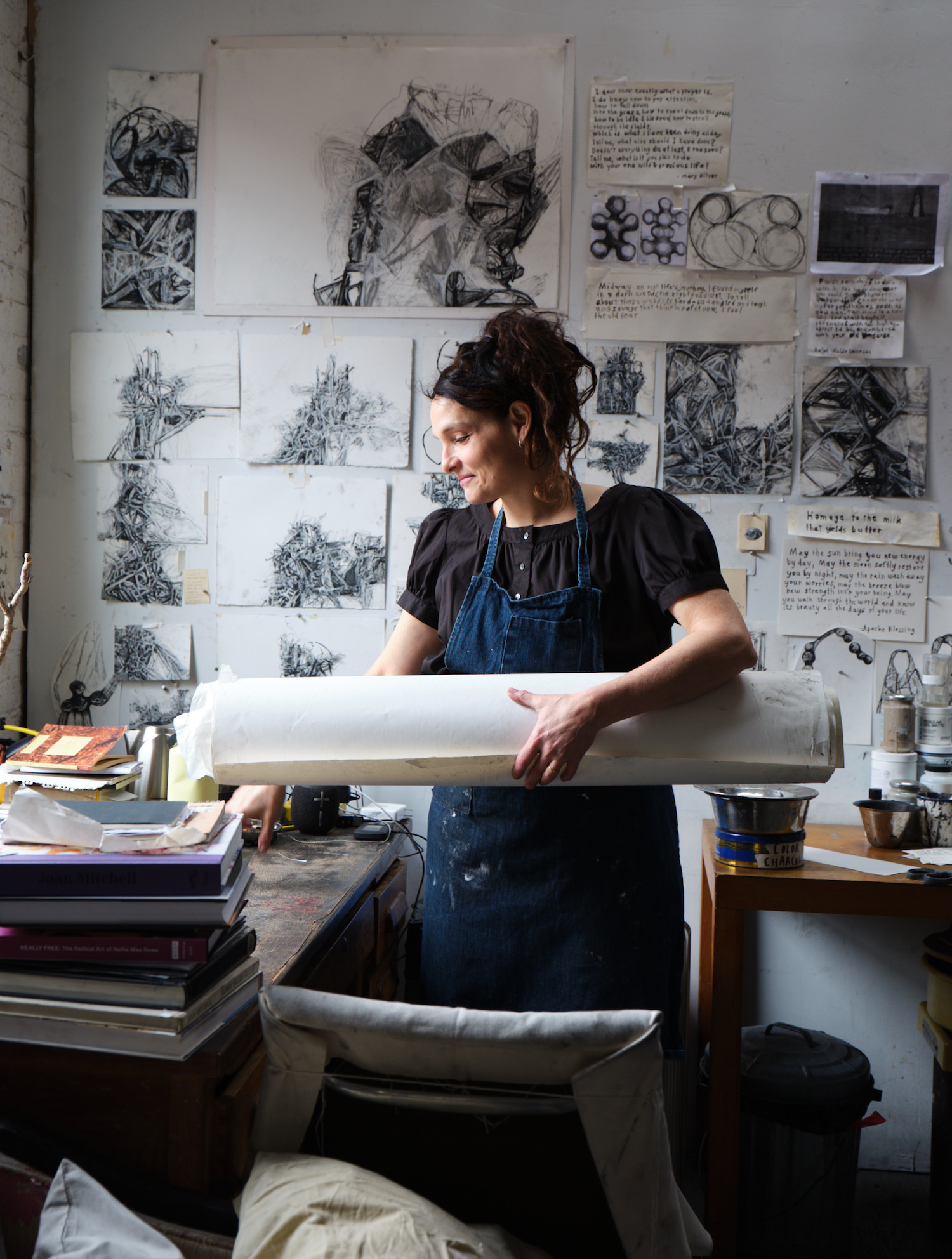
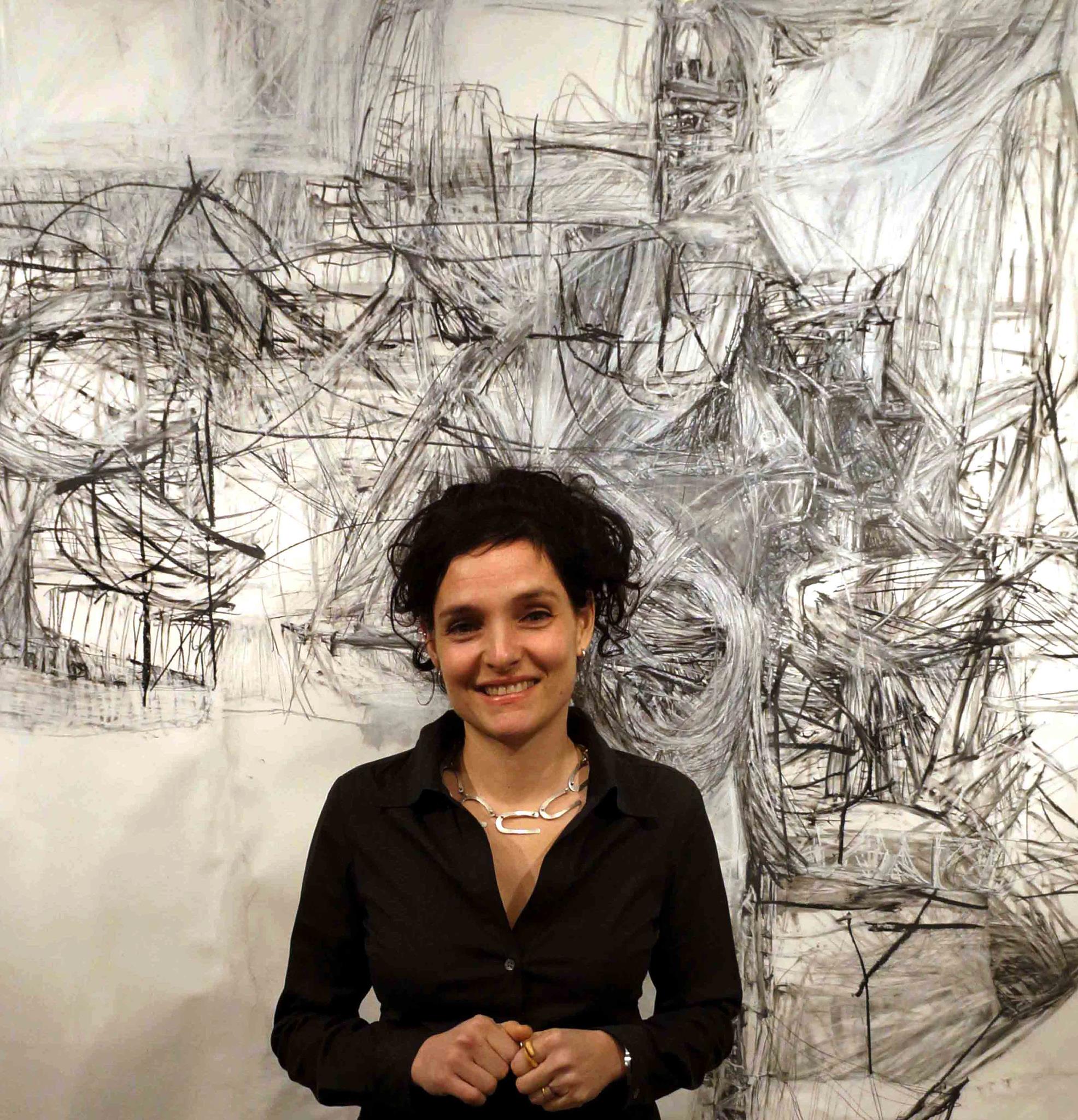
Tara, a visual artist who self describes as “a drawer,” makes, teaches, and studies drawing. She’s there to talk about her first public large-scale installation.
But the Boston, MA native doesn't lecture. She doesn't explain. Instead, she invites the room full of attendees to spend a few quiet moments looking at the drawings. Then she asks a question she has been asking for 30 years:
That question is the engine that drives the Visual Thinking Strategies Institute, a nonprofit whose mission is to share proven strategies to build visual literacy. VTS is a teaching method that has been reshaping how educators, and most recently medical students at top hospital teaching institutions, think about learning for more than three decades. And for Tara, it has become a life's work, one she inherited from her mother, Dr. Abigail Housen.
Learning to think about talking about art
A Boston cognitive psychologist, Dr. Housen began her art journey began where so many encounters with art begin, in a museum. There, she kept noticing that most people didn't feel at ease among the artwork, moving through galleries quickly, uncertain what to say or think. That observation became a decades-long obsession: she began systematically studying how people respond to art, conducting tens of thousands of interviews across diverse ages and backgrounds to map what she calls "Aesthetic Development." Her research, which has been cited in more than 230 publications, challenges the assumption that visual understanding comes naturally. Instead she found visual literacy requires practice. In the 1990s, while evaluating education programs at the Museum of Modern Art, (MOMA) in New York City, she met Philip Yenawine. Together they co-founded VTS, bringing evidence-based art education to teachers, beginners, and underserved communities worldwide.
Carrying the Art Literacy Legacy Forward
As Director of the Visual Thinking Strategies Institute, Tara carries on her Harvard-educated mother’s mission, which transformed museums, clinics and classrooms into places where people talk, question, and build meaning together. This laid the groundwork for more inclusive and effective education far beyond the art world.
Today, VTS is woven into the curriculum at medical schools including Harvard Medical School. Through the VTS training, residents, nursing students, and other healthcare professionals learn to strengthen observation and communication skills through the study of original works of art typically in classroom settings, with occasional treks to museums.
“Doctors, it turns out, need the same skills as seven-year-olds squirming in a classroom: the ability to slow down, look carefully, resist the first conclusion, and listen to what someone else sees,” she says.
The question, “What’s going on in this picture,” also includes a trio of other questions.
VTS facilitators ask students: "What is going on here?", "What do you see that makes you say that", is the one that drives the learning, and "What more can you find?" Students, engaged in a lively group discussion, listen, build on their initial first impression. They gain observation and critical thinking skills in this process, says Tara.
“The work we do to create visible ideas from nothing is, to me, stunning,” she says.
From the Classroom to the Canvas
Tara began her drawing in preschool, where she could always be found with a crayon or art pencil in hand. Tara has spent her life drawing, had solo shows, and taught drawing for every age student in public and private kindergarten through graduate school. Like her mother, she also researches the power of art to teach. Tara’s work has been funded by The National Science Foundation, in collaboration with a team of neuroscientists, to study “Harnessing the Power of Drawing for the Enhancement of Learning.” She is now researching eye motion in art viewing in the Boston Public Schools. She’s a ’97 Columbia University School of the Arts Visual Arts alumna. and has taught, for over a decade, in the Art & Art Education program at Teachers College. That lifelong practice of having a crayon or pencil always in hand, has taken her from solo shows in New York and Los Angeles — with galleries including Tibor de Nagy, Glenn Horowitz, and the National Arts Club — to collections at the Morgan Museum, the Parrish, and the Metropolitan Museum of Art. Two books document her work,
Back in the Barn
The VTS methodology, built on decades of research and refined in classrooms and medical schools across the country, doesn't live in a textbook. It lives in rooms like The Arts Center of Duck Creek.
On this August 2023 day, Tara is working alongside facilitator Jasanna Britton with 35 audience members to run a Visual Thinking Strategies (VTS) program at Duck Creek on the occasion of Tara’s exhibition.
There, Tara is everything: maker, teacher, inheritor of a mission. The drawings on the walls are hers. She is describing her art alongside facilitator Jasanna.
In response to her question, there is a beat of silence.
Someone offers something tentative. Tara paraphrases it back, not correcting, not affirming, just reflecting, and opens the floor. Someone else adds an observation. The drawings, which a moment ago were simply hanging there, are suddenly alive with competing meanings.
She speaks to attendees about Chinese concept of chi — the life force moving through early painting manuals — the idea that the force comes through the world, through the artist's arms, into the paper and out.
"What I'm aiming for," she says, "is for the work to be alive. Moving. Propulsive. Erupting."
It is not about technical perfection. It is not about the final product. It is about keeping something moving, and passing it on.
That philosophy — art as force, as transmission, as meeting people where they are — is the same one that animates everything else she does.
"I'm a Drawer"
Ask Tara, who now lives in New York City, what she is, and she will correct you gently. Not an artist. A drawer.
The distinction matters to her. In her Harlem studio with her dog beside her, she goes through hundreds of pencils making charcoal drawings.

“I think the most important part of drawing is seeing,” she says. “The more I look around me, the more the world opens up as if under a magnifying lens.”
What’s Next?
In the fall of 2026, Tara will be presenting at The Visual Arts in Healthcare Program at Brigham and Women’s Hospital’s international symposium, in Boston on September 23-25, 2026, This symposium aims to build community between the visual arts and healthcare professions, educators, and artists. She is also teaching in many of the trainings offered internationally by the VTS Institute online every month to the museum educators, artists and healthcare workers who sign up and discuss art across differences, learning how to drive measurable learning. Through an exchange of methodologies and emerging research, participants will share unique curricula and learn about the emerging evidence to improve healthcare professionals’ skills and effectiveness as well as positively impact patient outcomes.
Join Narrative Mindworks
Be part of a global community advancing the power of storytelling in healthcare, education, business, and the arts.
Whether you're a caregiver, educator, writer, or visual storyteller, narrative practices help us connect, heal, and preserve legacy. Join Narrative Mindworks to gain access to exclusive resources, share your story, and grow your impact.
Become A Member – Join Now