Key Takeaways
- Dr. Peter Orton was Steven Spielberg’s Story Editor before bringing storytelling into public health, corporate learning, and higher education.
- He believes facts and data are not enough. Professionals must learn to communicate through narrative.
- From Harvard to Johns Hopkins, Orton has studied what makes audiences listen, learn, and remember.

Peter will be teaching "Storytelling Skills for Health Communication" this summer semester at Johns Hopkins Bloomberg School of Public Health in Baltimore, MD.
1. Peter, your biography reads like a story in itself — Hollywood, Harvard, IBM, Johns Hopkins. How do you describe what you do?
I’m currently Director, Media Design of the Institute for Vaccine Safety at Johns Hopkins Bloomberg School of Public Health. My Stanford doctoral degree was in the “psychological process of media” which is about how adults learn from text, video, audio, animation, slides and computer. So my work at Johns Hopkins is using what I’ve learned to create effective communication design via the appropriate delivery medium. For example, it includes how to use visuals in PowerPoint slides instead of overwhelming audiences with slide after slide of on-screen text, and how to embed compelling story into fact-based presentations, and lots more.
From Spielberg's Writers' Room to Public Health
2. You spent years in Hollywood, including as Story Editor on Steven Spielberg's NBC prime-time series "Amazing Stories." What was that like, and what did it teach you?
As Story Editor, I had a wide range of different tasks. But my primary role was to ensure that each of the 22 scripts for that season’s shows were not only as compelling as they could be but also conformed to established guidelines, from the mundane -- such as NBC’s “Standards & Practices,” budget limitations, correct length (time) – to the creative (crisp plot development, well defined and engaging characters, visual moments, and more). It also included, depending on the episode, working on script changes during production to accommodate requests for on-set revisions.
The experience taught me many things. Perhaps the most surprising and important was that a Hollywood script is an ever-changing blueprint, changing even after the actors’ performances because it may revise yet again even in post-production.

Peter was Steven Spielberg's Story Editor for 22 episodes of NBC-TV's "Amazing Stories". "The Pumpkin Competition" episode was produced from his "spec script" that got him the job.
3. From Spielberg's writers' room to Harvard and IBM. How did that happen?
Actually, the order was Harvard first where I earned a Masters in Education and then taught public school in Arlington, Massachusetts. After become tenured, I realized my career dream was in writing film and TV stories, so I left teaching and took a $65 People’s Co-op Van from NYC to LA where for years I took screenwriting courses and wrote spec script after spec script until a few were good enough to get me an agent and paid assignments.
Although I had some wonderful experiences on a few shows, I soon realized that most working Hollywood writers make their living by writing scripts that, alas, are never produced. And indeed that’s exactly what I experienced most of my career: I’d spend many weeks, sometimes months, ensuring that every word in a script was exactly right, get paid well for it, and eventually learn that all my careful work was just one of the majority scripts that year that wasn’t chosen for production. So that realization that nearly all of my hard work would end up on a shelf with thousands of other unproduced scripts – made it easy to leave Hollywood. I enrolled in a Stanford doctoral program that combined my interest in media and teaching, and the degree eventually let to my being hired by IBM to create rich-media learning programs for their 380,000 global employees. The joy in that was that every script I thereafter wrote was shot and viewed as part of employee development programs and helped people learn skills and made them better at their work.
Storytelling at Scale
4. Your work at IBM got significant recognition. Can you say more about what made that program distinctive?
I think what made those programs distinctive is that we used the science from Stanford about effective media design, and embedding story into the learning programs to make them more engaging. For example, using visual media whenever we were teaching behavioral skills – following a “show, don’t just tell” approach – which uses the principles of observational learning. It’s no different now from what you see on YouTube to learn how to fix a toilet or shuck an oyster, but at the time – in the 1990s, before YouTube existed – learning using behavioral modeling via video was the new flavor of the month in corporate learning. Of course, now it’s everywhere.
 5. You've described some key elements of a good story. What are the fundamentals that anyone — a scientist, a healthcare worker, a nonprofit leader — should keep in mind?
If I had to give just one piece of fundamental advice about crafting a good story, it would be to ensure that both your protagonist – your “hero” – and your protagonist’s challenge are relatable to your audience. Both of these two elements must connect with your audience. If the both do, you will likely have your audience engaged. If one or the other pales, it will likely significantly diminish your audience’s interest. So the fundamental truth to “Know Thy Audience’ relates to those 2 elements of a story: protagonist and challenge.
The Elements of Story
6. That brings us to your new book, The Elements of Story. This feels like the culmination of decades of work. What is it, and why did you write it?
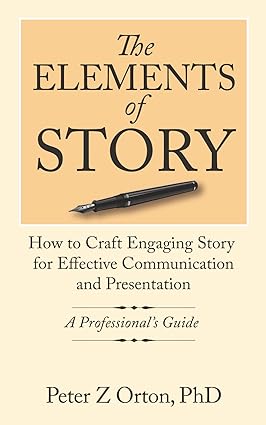
Peter's new guidebook is designed to help professionals craft and improve their stories. (It's now available at Amazon or Lulu's bookstore.)
I was fortunate in that the top leaders at IBM understood that one of the most powerful ways for their client-facing representatives to describe IBM’s products and services was not just by enumerating their features and functions but also by telling stories how their offerings create value. When they learned of my background, they asked if I would help to make IBM execs, salespeople and technical scientist’s better storytellers. Which I did, not only by giving hundreds of workshops but also creating web programs and applications.
When I retired from IBM, I continued to do that as a consultant to other Fortune 500s, NGOs, and non-profits. After being on too many airplanes and staying in too many hotels, I thought, “Why not put what I’ve learned about crafting story into a book?”
7. Why is The Elements of Story particularly relevant for Narrative Mindworks members?
What I’ve done in the book is I’ve shared the 2 sets of elements that I’ve learning about the science and art of story: The science informs what are the essential elements of every story, and for any story about an individual there are 6 elements. The art part are the practical insights I learned from my time in Hollywood as to what professional writers do to make a story more impactful for an audience. I’ve described 20 of the most powerful, to select from, depending upon topic, story, audience, and so on.
Storytelling, Science and Vaccine Communication
8. You've done serious research at Johns Hopkins on using narrative to address vaccine hesitancy. Tell us about that work.
Currently we are in the midst of several large field experiments assessing the power of video story to inform about the benefits and risks of vaccination. Unfortunately most medical doctors, epidemiologists, and scientists communicate typically by means of facts and data that they know to be validated and well established. But facts and data, while they may be true and important, often don’t have the same impact as a well-told story. We’ve already learned during the Covid pandemic that a big reason for the spread of medical misinformation has been the use of stories told online via social media. So scientists and medical professionals need to learn how to also embed narrative into their important work to be able to effectively communicate and share with patients what they know about vaccines benefits and risks.

Peter's first job in Hollywood was as a DGA (Directors Guild of America) trainee on a Warner Brothers show, "Freebie and the Bean."
9. You're also speaking at the International Dublin Writers' Festival this August. What will you be bringing to that conversation?
I look forward to sharing what I’ve learned about what science tells us about crafting a story, and what professionals have learned about making that story better.
10. What do you most hope Narrative Mindworks members take away from your work?
That the craft of storytelling is like any other craft: it can be learned and practiced and improved.
(Save the date for the Narrative Mindworks June 16th Book Club with Peter as featured author)
Join Narrative Mindworks
Be part of a global community advancing the power of storytelling in healthcare, education, business, and the arts.
Whether you're a caregiver, educator, writer, or visual storyteller, narrative practices help us connect, heal, and preserve legacy. Join Narrative Mindworks to gain access to exclusive resources, share your story, and grow your impact.
Become A Member – Join Now