
Life Happens, Laugh Anyway: Stephanie Goldklang on Comedy, Grief, and the Brother Who Believed in Her
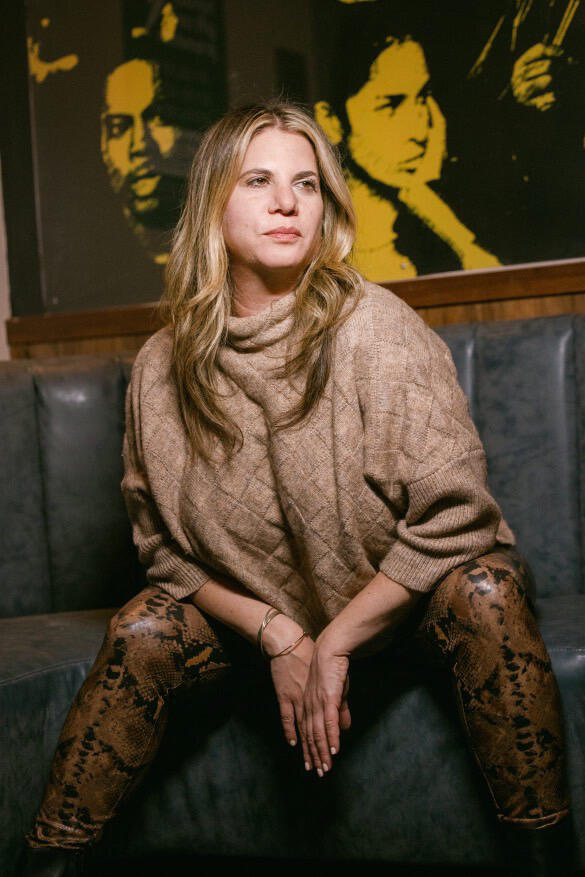
Before there was a stage, there was a station wagon.
Growing up in the Maryland suburbs of Washington, D.C., the three Goldklang kids piled into the family Buick the way kids do on long drives, Shelly buried in a book, Stephanie doing typical middle-child things, Jonathan wedged between them, tolerating two sisters who doted on him like extra mothers. They called themselves the Three Musketeers.
“I loved making my siblings, my brother in particular, laugh,” Stephanie says. “From a young age, that was it.” Her parents used to tell her it wasn’t her job to make her little brother laugh. She kept doing it anyway. Decades later, she’d call it their secret language.
— Stephanie Goldklang
That language followed them into adulthood, and it found its favorite stage in DC, New York City, and many cities in between. When they visited one another, the routine was almost always the same: a comedy club to catch a show, a diner, whatever slice of pizza was rumored to be the best in whichever neighborhood they'd landed in. Jonathan rated every bite like a critic building a citywide ranking, one slice at a time.
Fast forward a few years, and Stephanie would be the one on stage at those same clubs, working a room instead of watching one. She used to test her material on her brother first, too — long before either of them knew how much that habit would end up mattering.
Still Laughing
Jonathan Ross Goldklang was diagnosed with male breast cancer at 39, a diagnosis so rare that even his own doctors said they'd never seen a case quite like his. He was an elementary school teacher, a track coach, a guy who loved football and pizza. “Who is the face of cancer? It does not discriminate,” Stephanie says. “But him — it just didn't seem like it would go together at all.”
What followed would test, and eventually justify, an instinct Stephanie had been building her whole life: that healing runs on story and humor almost as much as it runs on medicine. It's the thread that ties together her three seemingly separate lives, a corporate consultant coaching executives, a stand-up working a room, a Narrative Medicine practitioner sitting in on hospital rounds.
She didn't have the language for it yet. She'd find it a few years later, in the middle of losing her brother.
The cancer had already reached his bones by the time doctors found it, Stage Four, the kind of diagnosis that comes with a prognosis attached. The family got almost four more years than anyone predicted. “We got four additional years with him,” Stephanie says. We went on a lot of road trips together.”
For nearly four years, through a final stretch mostly spent in the hospital, and an ICU stay chosen over hospice because he wanted to fight till the end, Stephanie was at his side.
She tested her material on him first, the way she always had. He'd laugh, and tell her, only half joking, that she was going to end up on Saturday Night Live.
“He really was my biggest champion. He believed in me in a way that — I don't have that anymore, that type of just unbridled support.”
“My brother and I would be laughing in the hospital, even in the most serious situations,” she says. “Finding humor to guide your conversations.”
The Room They Built
Near the end, when Jonathan moved to the ICU, his best friend Peter put together a photo collage and set it up where everyone entering the room would see it first: Jonathan healthy, Jonathan coaching track, Jonathan mid-laugh on a road trip. Not Jonathan hooked to a breathing machine.
“Everybody coming in would see him healthy,” Stephanie says. “They would see him not as somebody unwell, but somebody who was teaching children, who was smiling with me on a road trip.”
It's a small detail, but it's the whole thesis of how Stephanie approached that room: the diagnosis didn't get to be the only story. She and her family kept finding people to put back into the frame around it. The doctors were an oncology team at the University of Maryland Medical Center that Stephanie credits by name in a letter she wrote:: Dr. Vincent Ng, who first pushed the family to move fast on a bone biopsy; Dr. J.W. Snyder, who had Jonathan laughing through radiation; Dr. Eugene Koh, who helped a tumor board find a way to avoid surgery; and Dr. Paula Rosenblatt, Jonathan's oncologist, who treated him, in Stephanie's words, “like he is her only patient” for years in a category so rare that a support group for it didn't even exist.
But it wasn't only the doctors. There was the hospital cook who remembered Jonathan's order every single time he was in for treatment. And there was Towanda Thomas, a patient care technician, not a doctor, off duty and getting breakfast in the cafeteria one morning when she noticed Stephanie's mother didn't look right. Ellen Goldklang insisted she was fine, just worried about her son. Towanda didn't believe her, and didn't let it go.
She came back a second time, then a third, then finally called the ER herself without being asked. Within the hour, doctors found a saddle embolism cutting off Ellen's oxygen supply; she was breathing at roughly 72 percent capacity. Without Towanda, Stephanie believes, her mother would have died that day.
Stephanie tracked Towanda down afterward — a LinkedIn message, a week of silence, then confirmation — and brought her a necklace from Tiffany at Jonathan's next treatment. The whole hospital cafeteria filled with medical professional steam stood and applauded when Ellen and Towanda embraced.
When Stephanie later wrote about Jonathan's hospital experience for the University of Maryland's Great Stories Award, that's who the story was about: not just the oncologists, but Towanda, and the omelet cook, and everyone in between. Her letter was selected and read aloud at an event with the hospital's CEO and head of oncology in the room. She has it framed.
“It was about people, making this horrific experience feel like — I don't know — like a story. Not just a diagnosis.”
Where the Joie de Vivre Comes From
By the time Jonathan got sick, Stephanie had already spent thirteen years as the Executive Director of the Muscular Dystrophy Association (MDA) — running fundraising and government lobbying, supporting clinics out of Johns Hopkins Children's Hospital, running a summer camp that adapted horseback riding and swimming for kids whose bodies didn't work the way other kids' did.
“I was on the front lines of the advocacy side of it,” she says, not a clinician, never claiming to be one, but present, deliberately, at the hardest moments a family can face.
It was there that she first learned what it looks like to build a whole life around a body that isn't supposed to last as long as it does.”
During her years at MDA, Stephanie grew close to a young boy named Mattie J.T. Stepanek, the organization's Goodwill Ambassador for the D.C. region and, eventually, its National Goodwill Ambassador who won the hearts of millions of people across the globe. Mattie was born with a rare, inherited form of muscular dystrophy that had already taken three of his older siblings. He became one of the best-known child poets in the country, a bestselling author whose books of “Heartsongs” carried messages of faith, hope, and peace to readers well beyond the disability community, including a friendship with President Jimmy Carter that lasted the rest of his short life. Mattie died in June 2004, just weeks before his fourteenth birthday. Stephanie is still close with his mother, who carries the adult-onset form of the same disease.
“It was just very interesting that Narrative Medicine spoke to a lot of parts of my life,” Stephanie says. “Mattie and Jonathan, in very different registers, both had every reason not to find joy in what their bodies were doing to them. Neither one let that be the whole story.”
It isn't a lesson Stephanie can fully explain — she just calls it joie de vivre, and says it's the thing both of them handed her, whether they meant to or not: how to actually live inside a hard thing, instead of merely surviving it.
Three Careers, One Story
Ask Stephanie where the comedy came from, or the consulting, or Columbia, and she'll walk you through what sound like three different careers.
The instinct started decades before any of this, with a kid trying to make her little brother laugh. She and her father listened to Rodney Dangerfield on cassette tapes. In college at Syracuse, in the Alpha Phi house, she did impressions and told jokes on the stairwell and front stoop, her first unofficial comedy club and audience. She went on to business school with the idea of eventually starting her own healthcare nonprofit, an ambition she traces partly to her own mother, who lost her mother young to ovarian cancer; Stephanie is named for her grandmother (who coincidentally dreamt of becoming a stand-up comedian). Instead, a fascination with the positive psychology coming out of a career stint at Gallup pulled her into consulting, where she spent the next two decades quietly bringing a healthcare sensibility into corporate work. She measured physician and patient engagement at Gallup, then managing client engagements at PwC, Willis Towers Watson, Harvard Business Impact and, today, Korn Ferry.
But comedy as an actual vocation, stage time, clubs, a real bit, started later, about a decade ago when her friend finally encouraged her to take a class.
“I took a (comedy) class, and I was hooked,” she says.
She kept doing comedy on the side — open mics, then festivals, then getting “passed” at New York clubs, the informal vetting process that turns an amateur into a regular. Today she's a working comic across the city and well beyond it: Atlanta, Los Angeles, Tulsa, Tokyo, London, Copenhagen. She's shared a bill with John Oliver. In one especially on-brand coincidence, she once did a cabaret in London with a singer from Iron Maiden and Cutting Crew's touring crew — and years later invited him to travel from the UK to perform at a comedy show she is hosting in Jonathan's memory in NYC.
Her act today is what she dubs, “observational comedy” from her life in the business world, dating, global travel, and the everyday monotonies that turn out to be funny once you actually look at them.
She found a name for the connective tissue, Narrative Medicine, in 2020, at a women's symposium in New York, not long after Jonathan's diagnosis. A woman in the room described herself, simply, as “a healer,” and mentioned she'd trained at Columbia. Stephanie had never heard of the field. She looked it up that night, applied, and spent the next three years — the same three years she was losing her brother, in the middle of a pandemic — in Columbia's Narrative Medicine certificate program.
“A lot of what I wrote in the program was about my brother,” she says. “I was in it with his fight.”
Narrative Medicine gave her a framework for something she'd already been doing instinctively for twenty years: paying close, deliberate attention to the story underneath the diagnosis. It’s what the field calls attention, representation, and affiliation, less formally, “radical listening.”
“It's like — how are we connecting, to influence, to inspire, to have better outcomes, simply by communicating,” she says. “That, to me, is the nucleus of narrative medicine.”
She's brought the discipline everywhere else in her life: into medical appointments and hospital settings, into her stand-up sets, and increasingly into her consulting work, where she's started weaving narrative-medicine principles into how she coaches leaders executives, to actually listen to the people in front of them.
“I feel like it transcends the medical side, even,” she says. “What are you doing that's going to make that client feel like they were represented?”
Life Happens. Laugh Anyway.
This August 17th, for the third year running, Stephanie is hosting a comedy cabaret in Jonathan's memory, with proceeds going to the Breast Cancer Research Foundation. A friend recently designed a logo for Stephanie's comedy work — for the shows, the website, the version of herself that does all of this at once: comedian, storyteller, host, producer, consultant. Underneath it, one line: Life happens. Laugh anyway.
Stand Up Comedy Cabaret Show in Memory of Jonathan Goldklang
Date: Monday, August 17
Location: West Side Comedy Club
Doors Open: 6:30 p.m.
Showtime: 7:00 p.m.
The event features live stand-up comedy, musical performances, community raffle prizes, and an evening dedicated to celebrating Jonathan Goldklang's memory while raising funds for breast cancer research.
The evening features an impressive lineup of comedians, including Chase DuRousseau, Kaneez Surka, Rich Aronovitch, Chris Scopo, and Stephanie Goldklang, with special musical performances by Jordan Greenberg and guest Tony Moore, formerly of Iron Maiden and Cutting Crew.
Tickets: Comedy Cabaret with Heart
About Goldklang Comedy
Goldklang Comedy is the creative home of New York comedian, producer, and host Stephanie Goldklang. Through stand-up, storytelling, cabaret, and live events, Goldklang Comedy creates experiences that celebrate the humor found in everyday life while bringing communities together through laughter.
Stephanie's Comedic Journey
Stephanie Goldklang is a native Marylander who has made the Upper West Side of Manhattan home for nearly 15 years. Since 2017, she has performed in comedy clubs all over New York City — Carolines on Broadway, West Side Comedy Club, Rodney’s, New York Comedy Club, and Broadway Comedy Club — making audiences laugh with her self-deprecating, relatable, observational humor. She leverages her experience in the business world, global travel, dating, and the everyday monotonies of life to create material that comes alive for audiences. Prior to the pandemic, Stephanie competed in the 2020 Carolines March Madness Competition among 64 of New York City's best young comedians, and performed in numerous virtual and outdoor shows during the pandemic itself.
Media Contact
Sara Gable, Marketing & Community Outreach —
Join Narrative Mindworks
Be part of a global community advancing the power of storytelling in healthcare, education, business, and the arts.
Whether you're a caregiver, educator, writer, or visual storyteller, narrative practices help us connect, heal, and preserve legacy. Join Narrative Mindworks to gain access to exclusive resources, share your story, and grow your impact.
Become A Member – Join Now