
By Ryan McCarthy, MD, Program Director, West Virginia University School of Medicine, Berkeley Medical Center Internal Medicine Residency
*This article is part of Narrative Mindworks’ ongoing series on Spirituality in Medicine
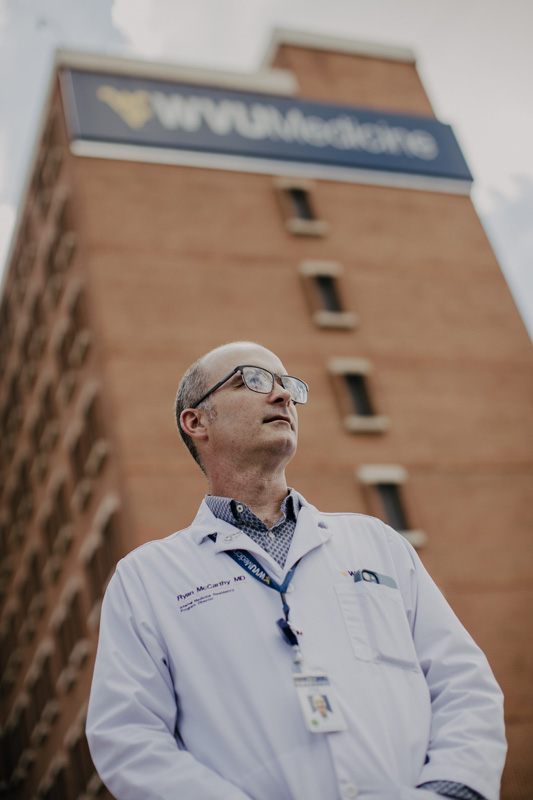
A chaplain named Wayne Clark once told Dr. Ryan McCarthy something that would reshape the way he practices medicine: "My job is to figure out what kind of moment someone is in, and to step into that moment with them." That insight changed McCarthy's entire practice, helping him recognize that every one of his patients carries a spirituality shaped by their own culture, religion, age, gender, and sense of how they want to live. Two decades into primary care in Martinsburg, West Virginia, his role, as he describes it, is to identify the moment a patient is having — crisis, triumph, fear, isolation, panic, pain, mortality — and to be present with them inside it, trying to see the situation from their point of view.
He calls that spiritually infused work, even when church, prayer, or worship never come up.
— Chaplain Wayne Clark, the insight that reshaped McCarthy's practice
"My job is to figure out what kind of moment someone is in, and to step into that moment with them."
— Chaplain Wayne Clark, the insight that reshaped McCarthy's practice
A Gap Buried in Multiculturalism
McCarthy believes narrative medicine has a real gap where spirituality should be — it tends to get folded into, or buried inside, broader discussions of multiculturalism, rather than treated as its own vital sign, even though faith and religion are often deeply tied to a person's sense of being and existing at all. Over his two decades in primary care, he's come to see that being in tune with a patient's value system — which he equates with their spirituality — is what makes a doctor a trusted guide rather than just a technician.
He brings as much medical competency as he can to every relationship, because that competency answers concrete questions, like why someone's gallbladder failed. But science, he's found, is the wrong tool for other questions entirely: what happens after death, what gives life meaning after a divorce, a retirement, or an estrangement from family. Science is the bedrock of his workday — surgery, medication, testing, therapy — but it isn't the only tool he needs.
That's why he resists any framing that treats faith and religion as "non-medical." They are, in his words, the practices through which people express some of their strongest convictions: how to live a virtuous life, what suffering means, what happens after death, why bad things happen to innocent people, and what justice looks like. He needs to respect a patient's concept of faith because it's the prism through which they see the world — and being dismissive of that worldview means failing to be present with them in their moment of need.
"It would be foolish to label faith/religion as 'non-medical' elements... it is the prism through which they view the world. If I am dismissive of their world view and values, then I am failing to be present with them in their moment of need."
Holistic Is Not Optional
In a state built from small towns, McCarthy says care has to be holistic — mental, physical, spiritual, and emotional all at once. "Otherwise, what is it?" he asks. He believes an increasingly digital world has only sharpened people's hunger for care that treats them as living, breathing, feeling beings — an "embodied" experience, without which he doesn't think real empathy is possible. We rarely say it out loud, he argues, but everyone wants to walk into a doctor's office and be seen and heard as a singular, complex human being, not a case file.
That kind of care starts small: a genuine "How are you?" and real curiosity about the person in front of him. From there, he can begin to trace the narrative thread of a patient's life — with active listening and the right body language signaling that he wants to know all about them. He's also felt the opposite, the unmistakable sting of a practitioner who made it clear they had no interest in holistic care — an experience he describes as a rejection that feels entirely personal.
He loves, as he puts it, "ambling down the cul de sacs" of a patient's life — old jobs, children, lovers, travel, pets, family, food, and, eventually, faith. There's no checklist of "holistic high points" to hit. Curiosity just keeps him pulling on the threads, and the topics surface on their own. Patients notice when someone is genuinely engaged, he says, and they respond in kind.
Where the Topic Gets Buried
Asked directly for examples of spirituality being embedded, buried, or ignored in patient care, McCarthy demurred — he felt he'd already answered the question elsewhere, in the way he talked about multiculturalism swallowing the topic, and about the sting of a doctor who clearly wasn't interested in a patient's whole life. For him, the "burying" isn't a single dramatic failure so much as the quiet, everyday habit of treating spirituality as adjacent to care rather than part of it.
Weaving Spirituality Into the Curriculum
For some clinicians, McCarthy acknowledges, spirituality will always be an itchy, awkward fit in narrative medicine — and that's fine. For others, himself included, it's a critical currency in caring for patients. But that doesn't mean he spends his day talking about religion. In fact, he tries to spend as little time as possible talking about religion, and as much time as possible listening — so he can understand what a patient values, who they are, what they're afraid of. The telling and receiving of stories, more than any direct conversation about faith, is how he experiences a patient's spirituality. When patients are offered the chance to reveal themselves, he's found, most of them enthusiastically take the offer.
In teaching, he sees spirituality as a rich vein for reflection and self-discovery — writing prompts and journaling around suffering, loneliness, isolation, sources of strength, and communities of support. He also has residents and students closely read artifacts that touch on birth, rebirth, death, or mortality, trusting that discussions will naturally drift into the spiritual realm on their own.
Learning Other Faiths, On Purpose
McCarthy is enthusiastic about the idea of adding a world religions component to narrative medicine pedagogy, framing it as an extension of the same curiosity that draws him to new foods, music, and other families' traditions. Stories from different faith traditions excite him, and he considers understanding them essential to practicing healthcare that embraces the full breadth of humanity. A good story, he notes, will always develop a crisis of some kind — and that's exactly when faith and spirituality get pulled in. Will those beliefs complicate the story? "You bet they will," he says — and that complication is the point.
The “Assholes” Test
McCarthy's own faith shapes his entire practice of medicine, starting with a belief that his gifts and abilities are meant to be shared for the benefit of others. It teaches him to look for good intentions in people and to extend grace constantly — to strangers, the lonely, the bereaved, the dying, and to even the most contrary patients. He's put it bluntly to his own residents:
— said in resident clinic teaching
"We don't get any credit for taking care of all the sweet grandmas in clinic today—that's easy. It's how we treat the ‘assholes’ who don't like us—that's where we demonstrate who we are."
— said in resident clinic teaching
Living up to that doing that requires patience, presence, and a willingness to start over completely with every single patient — something he admits is exhausting, and which he considers the central challenge of his career: bringing all of his time and talent into the exam room, focusing entirely on the person in front of him. He tries to do all of this without ever mentioning religion or faith directly to patients. That's the tricky territory he's chasing— moving through spiritual territory without naming it. His models for this are the best chaplains he works with, whom he admires for how smoothly they swim between faiths, making connections and personalizing the conversation to whatever the patient in front of them actually needs.
The Inventory Before the Door
McCarthy is unequivocal that clinicians need to take their own spiritual inventory before they can hold space for a patient's. Every single time, before he walks into a patient's room, he needs to get his emotions in check. For him, that means a deep breath and exhaling his own stress, problems, and worries so he can be fully present once he's inside.
— what McCarthy teaches residents in clinic
"Before you knock on that door, take a deep breath and drop your problems here in the hallway. Exhale and step into this room, focused on the patient in front of you."
— what McCarthy teaches residents in clinic
If he can leave his own baggage outside and enter in the right frame of mind, he's able to offer a patient the best of himself — a combination, as he describes it, of science, experience, faith, hope, love, and caffeine. Skip that inventory, he warns, and poor care becomes much more likely, because he won't be in the frame of mind to be a fully present, active listener.
Reading the Room, Reading the Person
McCarthy describes himself, only half-joking, as a "touchy-feely human" who's been caught crying at dog food commercials during the Super Bowl — so tuning into other people's emotions doesn't take much effort. It's part of why he became a primary care doctor: an innate interest in other people's stories, with spirituality as an inevitable thread running through them. His method starts with setting the scene as safely as he can, and letting everything else flow from there — including attention to the small, personal artifacts patients bring into the room with them.
"If they have a religious pendant or jewelry, ask them to tell you about it."
— a close-reading technique McCarthy teaches residents
Opening the Conversation
Raising the subject of faith without it feeling intrusive or presumptuous takes deliberate language. McCarthy has a handful of go-to questions, each designed to open a door without assuming what's behind it.
"During this time of illness and pain, are you relying on your faith?" / "Do you have a faith community supporting you during this time?"
— sample language McCarthy uses to open the conversation, without asking which faith
Notably, he isn't asking which faith a patient holds — that detail doesn't actually matter to him. What matters is understanding what role faith or religion plays in a person's life at all. With other patients, he normalizes the question by folding it into how he practices medicine generally:
"I ask all of my patients about their practices of faith and worship. Can I ask you about yours?"
— how McCarthy normalizes the question for patients
And with some, he frames it even more plainly, making clear that the specific religion is beside the point — what matters is whether it matters to them.
"It's not important to me what religion, church, or faith that my patients have. It is important, however, for me to know if it is important to my patients. I want to support the faith practices that support my patients."
Patients, he's found, are hungry to share, if given the chance.
When Belief and Treatment Collide
Spirituality gets harder to navigate when it runs headlong into a recommended treatment — a refused transfusion, a hope for miraculous healing. McCarthy's position is unambiguous: patients should be able to refuse any medical intervention they don't want, whether that's CPR, surgery, blood transfusions, vaccines, or an organ transplant. A person's spiritual beliefs, he says, are fundamental to which interventions they consider acceptable, right, or just — and he wants to respect the bodily autonomy those beliefs shape. A healthcare team's recommendations, in his framing, are exactly that: recommendations, not mandates.
Narrative and storytelling skills, he argues, are what make these encounters survivable — understanding why a patient doesn't want a particular intervention makes it far easier to honor their wishes, and honoring well-informed decisions is a priority for him as a physician. It's also, he notes, what he'd expect his own doctors to do for him.
"You have told me that you do not want blood products. Can you help me understand why this is so important to you?"
— a question McCarthy asks in these encounters
He often follows a similar thread with a second question, turning a patient's beliefs into something he explicitly wants to affirm, because he does:
"I want to respect you, and this includes your beliefs and limitations about treatments. Is it okay if we talk about that?"
His patients, he says, love this — knowing these topics are on his mind, and that there's room for the conversation at all.
Care Without a Congregation
Patients who identify as atheist, agnostic, or spiritual-but-not-religious get the same curiosity from McCarthy as anyone else. In his experience, people who identify as atheist want just as much out of life as anyone — the same hopes and fears, and the same claim to being asked what matters to them. It can be tempting to assume that not believing in a higher power means an absence of faith, but life has taught him otherwise. Many of his patients who've reflected deeply enough to land on atheism, he's found, have done real emotional work to decide what matters most to them.
"I have found that many of my patients who have reflected deeply enough to decide they are atheist have done the hard emotional work to decide what matters most to them. Isn't that an example of spirituality?"
With those patients, he reaches for a version of the same question, stripped of any religious framing at all:
"What matters most to you now that you have cancer?"
— a question McCarthy might ask a patient without a faith framework
It opens the same door as any of his faith-based questions — priorities, values, loved ones, and the limits of treatment — by staying focused entirely on the patient's own value system and working within it.
What It Takes Off the Page
McCarthy doesn't see hospitals as structurally hostile to spirituality — quite the opposite, in his experience. His own hospital is full of chaplains, preachers, priests, and community members visiting and praying with patients constantly, and he loves it — sharing a hug with a Hospice of the Panhandle worker in the entrance, saying hello to a pastor grabbing coffee. That's simply the kind of place Martinsburg, West Virginia, is, and he hopes it never changes. Having clergy and church members welcome in the hospital — everyone welcome, he stresses — is essential to the healthcare space functioning properly at all. His community is full of houses of worship, and to serve that community, he believes his hospital has to reflect it.
Real culture change, in his view, takes something beyond curriculum reform. He points to one story to illustrate what he means. About fifteen years ago, a patient of his was rushed to the hospital with a self-inflicted gunshot wound and died within the hour — a scene he says he can barely find words for. What he can describe is what happened afterward, in the parking lot of Berkeley Medical Center.
— on the aftermath of a patient's death by suicide
"There in the harsh sun reflecting off the black asphalt, we held hands, prayed, cried, and said words in memory of a man we all knew in some way."
— on the aftermath of a patient's death by suicide
EMS drivers, ER doctors, nurses, techs, clerks, and others who'd cared for the man gathered spontaneously with his family and a few neighbors who had rushed to the hospital. Two years later, McCarthy received a handwritten note from the man's widow, who had since moved to Maryland to be near her daughter. She wrote words of thanks for everyone who had gathered that day to honor her husband's life.
"By doing so, we told her — without saying a word — we are trying to be strong. And so can you."
For McCarthy, that parking lot is narrative medicine and spirituality in their purest, most unscripted form — no sermon, no curriculum, just people stepping into someone else's moment because it was theirs to share.
Join Narrative Mindworks
Be part of a global community advancing the power of storytelling in healthcare, education, business, and the arts.
Whether you're a caregiver, educator, writer, or visual storyteller, narrative practices help us connect, heal, and preserve legacy. Join Narrative Mindworks to gain access to exclusive resources, share your story, and grow your impact.
Become A Member – Join Now```