
In the first story in our new spirituality series, Andre F. Lijoi, MD, reflects on narrative medicine, faith, compassion, and the role of spiritual care in healing.
A Q & A with Andre F. Lijoi, MD, of York, Pennsylvania
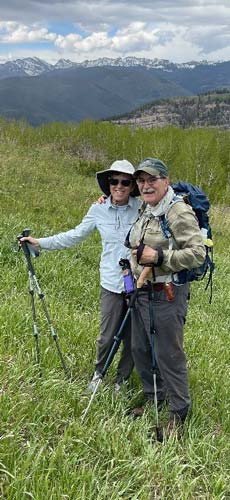
Andre and his wife on vacation in Minturn, CO.
At Narrative Mindworks, we are launching a new series of stories about the impact of spirituality in narrative practice. In the weeks and months that follow, we will showcase physicians, social workers, writers, artists and our members from all professions who are on the frontlines of weaving faith into their healing practices. This is the first story in that series.
Q: How did you first experience the spirituality of Narrative Medicine?
A: I learned about Narrative Medicine from my patients in the mountains of Kentucky long before we had a discipline. It was a narrative culture. Ask a question and you would get a story. Ask all the scripted questions you want, you'd get stories. This led me to discover a deep spiritual revealing as I listened to these stories and what they meant to the patients and their families. They were telling me so much more than their symptoms.
While they wanted to lead me to a diagnosis, they also wanted me to know about their humanity and what could be found beneath the surface and the layers below.
Q: Should care be holistic: mental, physical, spiritual and emotional?
A: I don’t know any other way to care for patients. There is a difference between being competent to order tests and prescribe treatment (which is very important and essential – it is a moral obligation to be competent) and being a healer. I think it comes down to being compassionate, to have habits that articulates that the patient has someone to walk with them in their suffering. Nothing outdoes compassion in health care. It works when everything else is not. Healing often takes place in the soul of the person before the physical can be seen or felt, according to Fr. Carl Tancredi, former Catholic Chaplain at York College of Pennsylvania and a priest in the Diocese of Harrisburg.
Q: Many in the Narrative Medicine community feel that spirituality in narrative medicine is a gap in discussions of multiculturalism -- but faith/religion/spirituality etc. are sometimes deeply tied to someone's belief in being/existing. Yes, there are radical outliers, but we would be ignorant to dismiss religion as a non-medical element? What are your thoughts about this?
A: In the course of illness patients often experience a spiritual crisis. This is aired out in the stories they present, whether restoration stories, quest stories or chaos stories. In these situations, patients retreat to their spiritual or religious instincts trying to manage the questions that present, trying to understand the crisis before them. Chaplains can be very helpful. Pastors vary in their ability and providing comfort of these chaplain services. There are studies that support health care professions consider a patient’s spiritual needs. Some wish that their religious beliefs are discussed and nearly half want their caregivers to pray with them. I think it is important for us to have a general question inquiring whether the patient has a spiritual component to their life that guides them in times of challenge. We can cultivate comfort with this conversation by including texts that enter into spiritual realms in our curriculum and programs.
Q: Are there specific close-reading or reflective writing exercises that you've found while working with patients?
A: I have found the work of John O’Donohue, Irish poet and philosopher, to be very well received. In his volume, To Bless the Space Between Us, every poem is a blessing. I have used Morning Offering, a daily Catholic devotional, with health professionals and patients, both in groups and individually. O’Donohue’s For Those Who Are Exhausted: A Blessing has been very well received by trainees and seasoned clinicians as well. I am planning a session using Georges de la Tours painting, The Penitent Magdalene, without giving the title up front for my monthly Grand Rounds session. I think there are numerous opportunities to infuse spirituality into medical practice especially drawing upon art from different traditions. Many poets provide a spiritual connection in their work. Mary Oliver’s Summer Day and Wild Geese are good examples. Wendell Berry’s, Fidelity is an excellent example of superb prose that provides a deep spiritual context.
Q: Has your own spiritual or philosophical orientation — whether religious, secular, or questioning — ever shaped the way you listened to or cared for a patient? How do you navigate that?
A: My approach to my medical work is predicated on “Vocation”, using one’s talents to the utmost to serve others and give glory to God. As a Catholic Christian physician I have opportunity to achieve this daily. My approach is influenced by Thomas Merton’s assertion in No Man is an Island, that, “For it seems to me that the first responsibility of the man of faith is to make his faith really part of his own life, not by rationalizing it, but living it,” and The Rule of St. Benedict that states, “The care of the sick and poor should be conducted as if one were caring for Christ himself.” This all revolves around God’s plan for me, “Give me what you have chosen for me and bring out in me what you desire from me.” (St. Augustine of Hippo) Essential to this approach is a constant awareness that I must never proselytize or be judgmental. The patient remains central as does the common humanity we share foundational. Regardless of tradition, this approach is welcomed and therapeutic. All that being said, it would be helpful to understand the tenets or other traditions. I think it comes down to what I learned from Edmund Pellegrino, MD early in my career, “when the Christian concept of person belies the physician-patient relationship, that relationship becomes one of caritas.” It goes directly to our ethic, of doing what is in the patient’s best interest, keeping their interests before me, avoiding harm, respect and their autonomy.
Q: Do you think clinicians need to do their own spiritual “inventory” before they can hold space for a patient’s? What does that look like in practice?
A: I think this is essential. Self-awareness is crucial not only to conduct a spiritually oriented practice but also for the Narrative Medical practice. Max Warren captures this concept so well, “Our first task in approaching other people, another culture, another religion, is to take off our shoes, for the place we are approaching is holy. Else we may find ourselves treading on men's dreams. More serious still, we may forget that God was here before our arrival.”
Q: When a patient’s spiritual beliefs conflict with the recommended course of treatment — for example, refusing a transfusion, or seeking miraculous healing — how does narrative medicine help (or complicate) that encounter?
A: The virtue of humility operates here. The right course is to be sure the patient understands the risks and benefits without demeaning them and then accepting our limitations. Brian Volck’s, Reading the Body, in Attending Others: A Doctor’s Education in Bodies and Words, addresses this, not so much in religious terms but cultural conflict, which is certainly applicable here.
Q: How do you minister to or attend to patients who identify as atheist, agnostic, or spiritual but not religious? Does narrative medicine offer a more neutral container for those conversations than traditional chaplaincy?
A: As a human being who shares a common humanity with me. This is one of the beautiful things about Narrative Medicine practice. It provides a safe space to explore what is most important to another, not needing common beliefs to promote discovery. What’s most important to me as a physician of faith is that I serve my patients and that my concern for their well-being is paramount. In this way the sermon becomes one of service, according to St. Francis of Assisi.
Q: Describe what you have termed, “the Sermon of Service.”
A: The sermon of service is so important when working with patients of different traditions, including atheism. I can’t speak with them about Jesus. My only option is to introduce them to Him by my actions that requires daily excursion into the Gospel, conversation with God, and humbly allowing Jesus to reside in me. That way it is possible that He loves through me. This is vital when caring for any patient. This is a very Franciscan concept and early in my career, as a public health service doctor in Eastern Kentucky our Catholic home was a Franciscan mission church where I learned about lay ministry.
Q: Are hospitals and health systems structurally resistant to integrating spirituality? What would it take — beyond curriculum changes — to shift the culture?
It is the Spiritual Care leadership that routinely participates in our Narrative Medicine program and I present seminars for the Chaplain residents and interns. The York Hospital President attends our sessions as does the leadership from institutional WellBeing. I have been a presenter for several WellBeing programs."
A: In our institution we have a Chaplain Residency and we have an institutional Department of Spiritual Care and Education. I have served on the Professional Advisory Group for the Residency for over 20 years. The leadership routinely participates in our Narrative Medicine program and I present seminars for the residents and interns. I believe this is unusual for a community hospital and while I think the inclusion of attention to spiritual care is expanding across the country, institutions are concerned with so many other competing issues, that there is a long way to go. Institutions do not incentivize this kind of care by the time constraints places on Health Caring Professionals and what they incentivize. There is lots of work to do.
About Dr. Lijoi
Dr. Lijoi is a 1980 Graduate of Georgetown University School of Medicine and completed Family Medicine Residency at the University of Maryland where he served as Chief Resident. He also served on the RRC for Family Medicine. He served in the Public Health Service in Eastern Kentucky’s Appalachian coal fields at the Mary Breckinridge Hospital in Hyden. He learned about Narrative Medicine from the patients he cared for there.
After his service he started a solo practice in Hanover PA and in 1995 moved to a full-time faculty position at the WellSpan York Hospital Family Medicine Residency. He has served as part-time faculty since 2023 and continues to direct the Narrative Medicine Program for residents.
He was named the 2008 PA Family Physician of the Year.
He established a curriculum in Narrative Medicine for residents in 2017 and offers a monthly Grand Rounds in Narrative Medicine. He completed the Certificate program in Narrative Medicine, Columbia University in 2019. He has presented nationally and internationally. He a regular presenter for Columbia University’s Virtual Workshops and a contributor to Narrative Mind Works. He is boarded in Family Medicine and Geriatrics. He has served on numerous ABFM committees and has chaired the ACGME Final Appeals Board.
When asked about his interest in patient stories, he replies, “I can’t work without them.”
Join Narrative Mindworks
Be part of a global community advancing the power of storytelling in healthcare, education, business, and the arts.
Whether you're a caregiver, educator, writer, or visual storyteller, narrative practices help us connect, heal, and preserve legacy. Join Narrative Mindworks to gain access to exclusive resources, share your story, and grow your impact.
Become A Member – Join Now```